

AI Recommendation Engine Visual System Overview
“How user signals become personalized recommendations.”
Project Overview
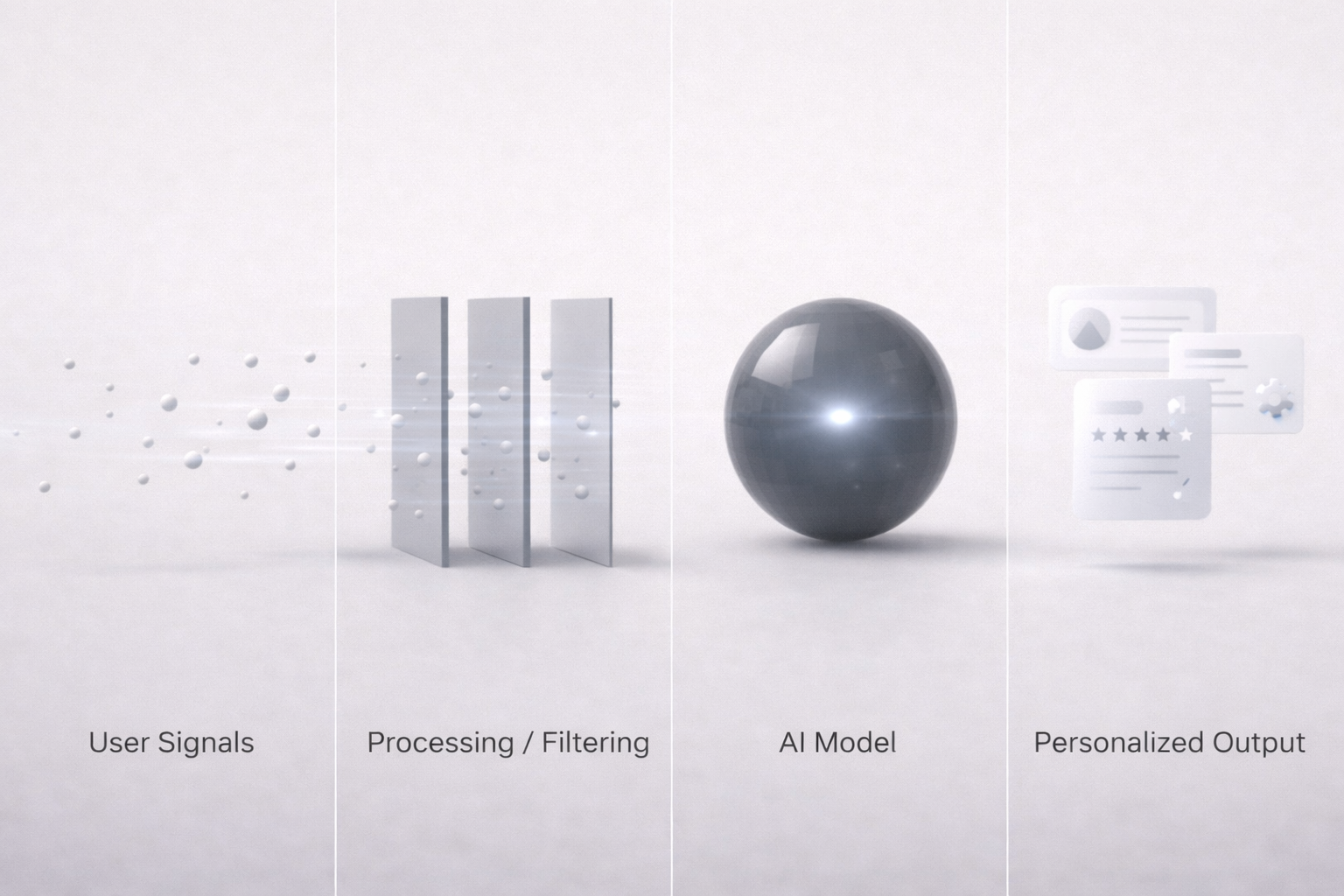
This project explores how abstract AI decision-making can be visualized through a simple, readable 3D system. Using minimal geometry and restrained materials, the scene represents how data passes through a filtering mechanism, is processed by a central AI core, and outputs a single selected result.
The goal was not to create a sci-fi depiction of AI, but rather a calm, analytical visualization that communicates logic, hierarchy, and selection in a way that feels intentional and human-designed.
Four Stages
User Signals are shown as loosely moving spheres, representing unstructured behavioral data.
Processing & Filtering introduces structured gates that refine and prioritize these inputs.
The AI Model is represented as a stable central core, suggesting controlled intelligence rather than a “black box.”
Finally, Personalized Output reduces complexity into a clear, focused result what the user actually experiences.
This system emphasizes that effective AI design isn’t about visual complexity, but about clarity, trust, and intentional decision making.
User Signals
This stage visualizes raw user signals before any processing occurs. I represented inputs as simple, uniform spheres to reflect how data enters AI systems without context or hierarchy. The minimal motion and neutral materials emphasize this pre intelligence state, setting a clear baseline for the transformation that follows.
Processing & Filtering
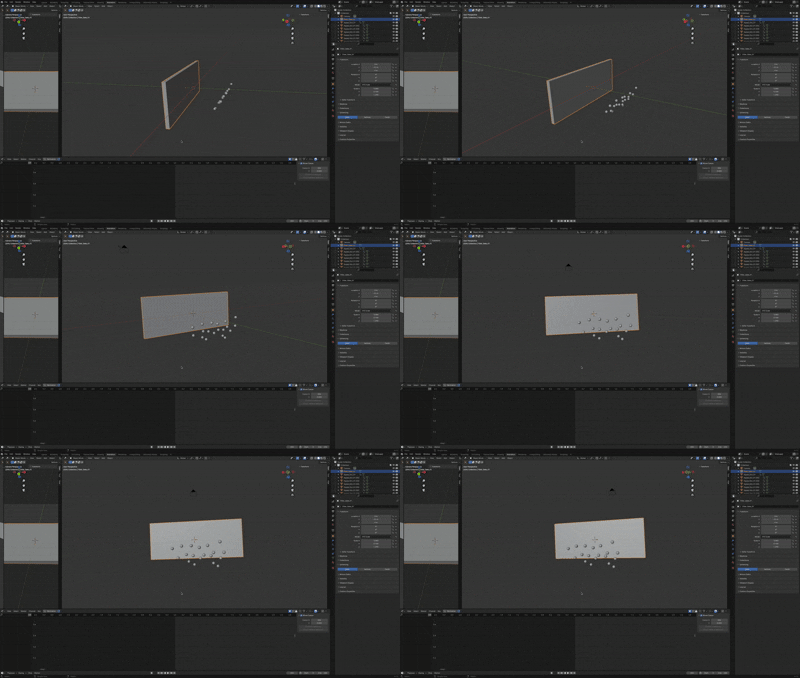
In the second stage, I introduced a filter gate to represent how AI systems reduce noise before intelligence is applied.
Not all user signals are equally relevant. To communicate this, I added a single, planar gate positioned directly in the path of the incoming data. As the signals pass through, only a subset continues forward while others are intentionally filtered out and removed from the flow
Visually, the contrast between signals that pass through and those that disappear creates a clear moment of selection. This helps the viewer intuitively understand that intelligence begins not with answers, but with what the system chooses to ignore.
AI Core (Model Processing)
After filtering, the remaining user signals enter the AI core — the point where computation and interpretation occur.
As the filtered signals approach the core, their motion subtly reorients inward. Rather than colliding or reacting dramatically, they are absorbed calmly, suggesting that the model integrates inputs holistically rather than processing them in isolation.
Personalized Output
The final stage represents the system’s output the moment where processed intelligence becomes actionable and user facing
Rather than visualizing output as a burst of multiple results, I intentionally reduced it to a single, refined form. This decision emphasizes clarity over volume, reflecting how effective AI systems prioritize relevance rather than abundance